Whats That Vow You Take When You Dont Have Sex Again
Celibacy (from Latin caelibatus) is the state of voluntarily being single, sexually abstemious, or both, ordinarily for religious reasons. It is frequently in clan with the role of a religious official or devotee.[ane] In its narrow sense, the term celibacy is applied only to those for whom the unmarried state is the result of a sacred vow, deed of renunciation, or religious conviction.[i] [2] In a wider sense, it is commonly understood to merely mean forbearance from sexual practice.[ane] [2] [3] [4] [5]
Celibacy has existed in one form or another throughout history, in nearly all the major religions of the earth, and views on it have varied.
Classical Hindu culture encouraged asceticism and celibacy in the later stages of life, after one has met i's societal obligations. Jainism, on the other hand, preached consummate celibacy even for young monks and considered celibacy to be an essential behavior to attain moksha. Buddhism is similar to Jainism in this respect. There were, however, significant cultural differences in the various areas where Buddhism spread, which afflicted the local attitudes toward celibacy. A somewhat like state of affairs existed in Nippon, where the Shinto tradition likewise opposed celibacy. In near native African and Native American religious traditions, celibacy has been viewed negatively as well, although there were exceptions like periodic celibacy practiced by some Mesoamerican warriors.[half dozen]
The Romans viewed celibacy as an aberration and legislated fiscal penalties confronting information technology, with the exception of the Vestal Virgins, who took a 30-year vow of chastity in order to devote themselves to the written report and correct observance of state rituals.
In Christianity, celibacy means the promise to live either virginal or celibate in the future. In addition to the Roman Catholic Church and the Orthodox Churches, the Anglican Communion and some Protestant churches or communities such as the Shakers also know a hope or vow of celibacy for instance for religious, hermits, consecrated virgins and deaconesses.
Judaism and Islam have denounced celibacy, as both religions emphasize wedlock and family unit life.[7] [eight] However, the priests of the Essenes, a Jewish sect during the Second Temple period, practised celibacy. Several hadiths indicate that Prophet Muhammad denounced celibacy.
Etymology [edit]
The English language discussion celibacy derives from the Latin caelibatus, "state of being single", from Latin caelebs , meaning "unmarried". This word derives from two Proto-Indo-European stems, * kaiwelo- "solitary" and * lib(h)s- "living".[9]
Abstinence and celibacy [edit]
The words abstinence and celibacy are often used interchangeably, only are not necessarily the aforementioned thing. Sexual abstinence, also known as continence,[x] is abstaining from some or all aspects of sex activity, often for some limited period of time,[11] while celibacy may be defined as a voluntary religious vow not to ally or engage in sexual activity.[12] [13] [14] [15] Asexuality is usually conflated with celibacy and sexual abstinence, but it is considered singled-out from the two,[16] [17] as celibacy and sexual abstinence are behavioral and those who use those terms for themselves are by and large motivated by factors such as an individual'southward personal or religious beliefs.[xviii]
A. Westward. Richard Sipe, while focusing on the topic of celibacy in Catholicism, states that "the well-nigh unremarkably causeless definition of celibate is simply an unmarried or single person, and celibacy is perceived as synonymous with sexual forbearance or restraint."[19] Sipe adds that even in the relatively uniform milieu of Cosmic priests in the United States there seems to be "simply no clear operational definition of celibacy".[xx] Elizabeth Abbott commented on the terminology in her A History of Celibacy (2001) that she "drafted a definition that discarded the rigidly pedantic and unhelpful distinctions between celibacy, chastity and virginity".[21]
The concept of "new" celibacy was introduced by Gabrielle Brown in her 1980 book The New Celibacy.[22] In a revised version (1989) of her volume, she claims abstinence to be "a response on the outside to what's going on, and celibacy is a response from the inside".[23] According to her definition, celibacy (even short-term celibacy that is pursued for non-religious reasons) is much more than not having sex. It is more intentional than abstinence, and its goal is personal growth and empowerment. This new perspective on celibacy is echoed past several authors including Elizabeth Abbott, Wendy Keller, and Wendy Shalit.[24]
Buddhism [edit]

Buddhist monks in Chiang Mai Province, Thailand
The rule of celibacy in the Buddhist organized religion, whether Mahayana or Theravada, has a long history. Celibacy was advocated as an platonic rule of life for all monks and nuns by Gautama Buddha, except for Japan where information technology is not strictly followed due to historical and political developments following the Meiji Restoration. In Japan, celibacy was an platonic among Buddhist clerics for hundreds of years. But violations of clerical celibacy were so common for so long that, finally, in 1872, state laws fabricated marriage legal for Buddhist clerics. Subsequently, ninety percent of Buddhist monks/clerics married.[25] An example is Higashifushimi Kunihide, a prominent Buddhist priest of Japanese royal beginnings who was married and a father whilst serving as a monk for most of his lifetime.
Gautama, later known as the Buddha, is known for his renunciation of his wife, Princess Yasodharā, and son, Rahula. In order to pursue an austere life, he needed to renounce aspects of the impermanent earth, including his married woman and son. Later on both his wife and son joined the ascetic community and are mentioned in the Buddhist texts to have become enlightened. In another sense, a buddhavacana recorded the zen patriarch Vimalakirti as beingness an advocate of marital continence instead of monastic renunciation, the sutra became somewhat popular due to its brash humour as well as integrating the office of women in laity as well every bit spiritual life.[26]
Brahma Kumaris [edit]
In the religious movement of Brahma Kumaris, celibacy is also promoted for peace and to defeat power of animalism.[27] [28]
Christianity [edit]


St. John the Baptist in the Wilderness by Raphael, circa 1517
There is no commandment in the New Attestation that Jesus Christ's disciples have to live in celibacy.[29] although it is a full general view that Christ himself lived a life of perfect chastity, thus "Voluntary chastity is the imitation of him who was the virgin Son of a virgin Mother".[thirty] One of his invocations is "King of virgins and lover of stainless chastity" (Rex virginum, amator castitatis) [31] [32]
Paul the Apostle emphasized the importance of overcoming the desires of the mankind and saw the country of celibacy being superior to the marriage.[33] Paul made parallels between the relations betwixt spouses and God'southward human relationship with the church. "Husbands beloved your wives even as Christ loved the church. Husbands should honey their wives as their own bodies." (Ephesians 5:25–28). The early Christians lived in the belief that the Stop of the Globe would before long come upon them, and saw no point in planning new families and having children. According to Chadwick, this was why Paul encouraged both celibate and marital lifestyles[29] amidst the members of the Corinthian congregation, regarding celibacy as the preferable of the two.[29]
In the counsels of perfection (evangelical counsels) Jesus Christ "gave the rule of the college life founded upon his own most perfect live. According to this counsels persons may be chosen to voluntary celibacy".[34]
A number of early on Christian martyrs were women or girls who had given themselves to Christ in perpetual virginity, such as Saint Agnes and Saint Lucy. According to about Christian thought, the first sacred virgin was Mary, the mother of Jesus, who was consecrated by the Holy Spirit during the Annunciation. Tradition also has it that the Apostle Matthew consecrated virgins. In the Cosmic Church and the Orthodox churches, a consecrated virgin, is a woman who has been consecrated past the church to a life of perpetual virginity in the service of God.
Desert Fathers [edit]
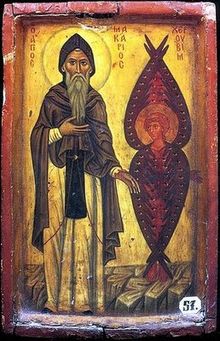
The Desert Fathers were Christian hermits, and ascetics[35] who had a major influence on the development of Christianity and celibacy. Paul of Thebes is often credited with being the first hermit or anachorite to go to the desert, simply it was Anthony the Great who launched the move that became the Desert Fathers.[36] Quondam around AD 270, Anthony heard a Sunday sermon stating that perfection could be achieved by selling all of one'due south possessions, giving the proceeds to the poor, and post-obit Christ.(Matt. 19.21) He followed the advice and made the further pace of moving deep into the desert to seek consummate solitude.[35]
Over time, the model of Anthony and other hermits attracted many followers, who lived solitary in the desert or in small groups. They chose a life of extreme divineness, renouncing all the pleasures of the senses, rich food, baths, residual, and anything that made them comfortable.[37] Thousands joined them in the desert, mostly men but also a handful of women. Religious seekers also began going to the desert seeking advice and counsel from the early Desert Fathers. By the time of Anthony's decease, there were so many men and women living in the desert in celibacy that it was described as "a metropolis" by Anthony's biographer.[35]
The first Conciliar document on clerical celibacy of the Western Christian Church (Synod of Elvira, c. 305 can. xxxiii) states that the discipline of celibacy is to refrain from the use of marriage, i.due east. refrain from having lecherous contact with one's spouse.[38]
Co-ordinate to the later St. Jerome (c. 347 – 420), celibacy is a moral virtue, consisting of living in the mankind, merely outside the flesh, and and so beingness not corrupted by information technology (vivere in carne praeter carnem). Celibacy excludes not only libidinous acts, but also sinful thoughts or desires of the flesh.[39] Jerome referred to marriage prohibition for priests when he claimed in Confronting Jovinianus that Peter and the other apostles had been married before they were chosen, but subsequently gave up their marital relations.[40] Celibacy every bit a vocation may be independent from religious vows (every bit is the example with consecrated virgins, ascetics and hermits).[ citation needed ] In the Catholic, Orthodox and Oriental Orthodox traditions, bishops are required to be chaste.[41] [42] [ citation needed ] In the Eastern Cosmic and Orthodox traditions, priests and deacons are allowed to exist married, yet accept to remain celibate if they are single at the time of ordination.[43] [44]
Augustinian view [edit]

Nuns in procession, French manuscript, c. 1300
In the early Church, higher clerics lived in marriages. Augustine of Hippo was 1 of the kickoff to develop a theory that sexual feelings were sinful and negative. Augustine taught that the original sin of Adam and Eve was either an act of foolishness (insipientia) followed by pride and disobedience to God, or else inspired by pride.[45] The first couple disobeyed God, who had told them not to eat of the tree of the knowledge of skilful and evil (Gen 2:17).[46] The tree was a symbol of the order of cosmos.[47] Self-centeredness made Adam and Eve eat of information technology, thus failing to acknowledge and respect the world every bit it was created by God, with its hierarchy of beings and values.[48] They would non have fallen into pride and lack of wisdom, if Satan had not sown into their senses "the root of evil" (radix mali).[49] Their nature was wounded by concupiscence or libido, which affected human being intelligence and volition, as well as affections and desires, including sexual desire.[50] The sin of Adam is inherited past all man beings. Already in his pre-Pelagian writings, Augustine taught that original sin was transmitted by concupiscence,[51] which he regarded as the passion of both soul and torso,[52] making humanity a massa damnata (mass of perdition, condemned crowd) and much enfeebling, though not destroying, the freedom of the will.
In the early on tertiary century, the Canons of the Apostolic Constitutions decreed that only lower clerics might still marry after their ordination, merely marriage of bishops, priests, and deacons were not allowed.[53] [54] [55]
After Augustine [edit]
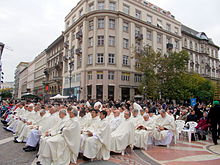
Catholic priests from all over the world in Budapest, 2013
I explanation for the origin of obligatory celibacy is that it is based on the writings of Saint Paul, who wrote of the advantages of celibacy allowed a human being in serving the Lord.[56] Celibacy was popularised by the early Christian theologians similar Saint Augustine of Hippo and Origen. Some other possible explanation for the origins of obligatory celibacy revolves around more practical reason, "the need to avoid claims on church building property by priests' offspring".[57] It remains a affair of Canon Constabulary (and often a benchmark for certain religious orders, peculiarly Franciscans) that priests may not own land and therefore cannot pass it on to legitimate or illegitimate children. The land belongs to the Church through the local diocese every bit administered by the Local Ordinary (usually a bishop), who is often an ex officio corporation sole. Celibacy is viewed differently by the Cosmic Church and the various Protestant communities. Information technology includes clerical celibacy, celibacy of the consecrated life, voluntary lay celibacy, and celibacy exterior of marriage.[ citation needed ]
The Protestant Reformation rejected celibate life and sexual continence for preachers. Protestant chaste communities take emerged, especially from Anglican and Lutheran backgrounds.[ commendation needed ] A few minor Christian sects advocate celibacy as a better way of life. These groups included the Shakers, the Harmony Gild and the Ephrata Cloister.[58]
Many evangelicals prefer the term "forbearance" to "celibacy". Bold everyone will marry, they focus their word on refraining from premarital sex and focusing on the joys of a future spousal relationship. Only some evangelicals, specially older singles, desire a positive message of celibacy that moves across the "expect until marriage" message of abstinence campaigns. They seek a new understanding of celibacy that is focused on God rather than a futurity marriage or a lifelong vow to the Church.[59]
There are also many Pentecostal churches which practice celibate ministry building. For instance, The full-time ministers of the Pentecostal Mission are celibate and generally single. Married couples who enter total-time ministry building may become chaste and could be sent to different locations.[threescore]
Catholic Church [edit]

During the first three or 4 centuries, no law was promulgated prohibiting clerical matrimony. Celibacy was a matter of choice for bishops, priests, and deacons.[61]
Statutes forbidding clergy from having wives were written offset with the Council of Elvira (306) but these early on statutes were non universal and were oft defied past clerics so retracted by bureaucracy.[62] The Synod of Gangra (345) condemned a false asceticism whereby worshipers boycotted celebrations presided over past married clergy."[63] The Churchly Constitutions (c. 400) excommunicated a priest or bishop who left his wife 'nether the pretense of piety"' (Mansi, 1:51).[64]
"A famous alphabetic character of Synesius of Cyrene (c. 414) is evidence both for the respecting of personal decision in the affair and for contemporary appreciation of celibacy. For priests and deacons clerical matrimony continued to be in vogue".[65]
"The Second Lateran Council (1139) seems to have enacted the first written law making sacred orders a diriment impediment to matrimony for the universal Church."[62] Celibacy was kickoff required of some clerics in 1123 at the Commencement Lateran Quango. Because clerics resisted it, the celibacy mandate was restated at the Second Lateran Council (1139) and the Council of Trent (1545–64).[66] In places, coercion and enslavement of clerical wives and children was apparently involved in the enforcement of the constabulary.[67] "The earliest decree in which the children [of clerics] were declared to exist slaves and never to be enfranchised [freed] seems to have been a canon of the Synod of Pavia in 1018. Similar penalties were promulgated against wives and concubines (see the Synod of Melfi, 1189 tin. xii), who by the very fact of their unlawful connexion with a subdeacon or clerk of college rank became liable to exist seized by the over-lord".[67] Celibacy for priests continues to be a contested issue even today.
In the Roman Catholic Church, the Twelve Apostles are considered to have been the first priests and bishops of the Church. Some say the call to be eunuchs for the sake of Heaven in Matthew 19 was a call to be sexually continent and that this developed into celibacy for priests as the successors of the apostles. Others see the phone call to be sexually continent in Matthew 19 to be a caution for men who were also readily divorcing and remarrying.
The view of the Church is that celibacy is a reflection of life in Heaven, a source of detachment from the material world which aids in one's relationship with God. Celibacy is designed to "consecrate themselves with undivided heart to the Lord and to "the affairs of the Lord, they give themselves entirely to God and to men. Information technology is a sign of this new life to the service of which the Church'south government minister is consecrated; accepted with a joyous heart celibacy radiantly proclaims the Reign of God."[68] In contrast, Saint Peter, whom the Church building considers its starting time Pope, was married given that he had a mother in law whom Christ healed (Matthew viii).
Usually, only chaste men are ordained as priests in the Latin Rite.[69] [lxx] Married clergy who have converted from other Christian denominations can be ordained Roman Catholic priests without condign celibate.[71] Priestly celibacy is non doctrine of the Church (such as the belief in the Assumption of Mary) just a matter of bailiwick, like the employ of the vernacular (local) language in Mass or Lenten fasting and abstinence.[72] As such, information technology can theoretically modify at whatever fourth dimension though it still must be obeyed by Catholics until the change were to take identify. The Eastern Cosmic Churches ordain both celibate and married men. Notwithstanding, in both the Due east and the West, bishops are chosen from amidst those who are chaste.[73] [74] In Ireland, several priests have fathered children, the two about prominent being Bishop Eamonn Casey and Father Michael Cleary.

Discalced Carmelites from Argentina, 2013
The classical heritage flourished throughout the Center Ages in both the Byzantine Greek E and the Latin West. When discerning the population of Christendom in Medieval Europe during the Middle Ages, Will Durant, referring to Plato'due south ideal community, stated on the oratores (clergy):[75]
"The clergy, like Plato's guardians, were placed in dominance not by the suffrages of the people, just by their talent as shown in ecclesiastical studies and assistants, by their disposition to a life of meditation and simplicity, and (perhaps information technology should exist added) by the influence of their relatives with the powers of country and church. In the latter half of the period in which they ruled [Advertising 800 onwards], the clergy were as free from family unit cares as even Plato could want; and in some cases it would seem they enjoyed no little of the reproductive liberty accorded to the guardians. Celibacy was office of the psychological construction of the power of the clergy; for on the 1 manus they were unimpeded by the narrowing egoism of the family, and on the other their apparent superiority to the telephone call of the mankind added to the awe in which lay sinners held them …"[75]
With respect to clerical celibacy, Richard P. O'Brien stated in 1995, that in his opinion, "greater agreement of homo psychology has led to questions regarding the touch of celibacy on the man development of the clergy. The realization that many not-European countries view celibacy negatively has prompted questions concerning the value of retaining celibacy as an absolute and universal requirement for ordained ministry in the Roman Cosmic Church".[76]
Chaste homosexual Christians [edit]
Some homosexual Christians choose to be chaste post-obit their denomination'due south teachings on homosexuality.[77]
In 2014, the American Clan of Christian Counselors amended its code of ethics to eliminate the promotion of conversion therapy for homosexuals and encouraged them to be celibate instead.[77]
Hinduism [edit]

A sadhu past the Ghats on the Ganges, Varanasi, 2008
In Hinduism, celibacy is usually associated with the sadhus ("holy men"), ascetics who withdraw from order and renounce all worldly ties. Celibacy, termed brahmacharya in Vedic scripture, is the fourth of the yamas and the word literally translated means "dedicated to the Divinity of Life". The word is often used in yogic practise to refer to celibacy or denying pleasure, merely this is but a small function of what brahmacharya represents. The purpose of practicing brahmacharya is to keep a person focused on the purpose in life, the things that instill a feeling of peace and contentment. Information technology is also used to cultivate occult powers and many supernatural feats, chosen siddhi.
Islam [edit]
Islamic attitudes toward celibacy have been complex, Muhammad denounced it, all the same some Sufi orders embrace it. Islam does not promote celibacy; rather it condemns premarital sexual practice and extramarital sex. In fact, co-ordinate to Islam, marriage enables ane to accomplish the highest form of righteousness inside this sacred spiritual bail simply the Qur'an does not state it as an obligation. The Qur'an (57:27) states, "Only the Monasticism which they invented for themselves, We did non prescribe for them but but to please God therewith, but that they did non detect it with the right observance." Therefore, religion is conspicuously non a reason to stay unmarried although people are allowed to live their lives however they are comfortable; only relationships and sexual activity outside of marriage, allow alone forced marriage, is definitely a sin, "Oh y'all who believe! Yous are forbidden to inherit women against their will" (4:xix). In add-on, wedlock partners can exist distractions from practicing religion at the same time, "Your mates and children are only a trial for you lot" (64:15) however that nevertheless does not mean Islam doesn't encourage people who have sexual desires and are willing to marry. Anyone who doesn't (intend) to get married in this life can ever practice it in the Hereafter instead.
Celibacy appears as a peculiarity amongst some Sufis.[78]
Celibacy was expert by women saints in Sufism.[79] Celibacy was debated along with women'due south roles in Sufism in medieval times.[lxxx]
Celibacy, poverty, meditation, and mysticism within an ascetic context along with worship centered around Saint'south tombs were promoted by the Qadiri Sufi gild amongst Hui Muslims in People's republic of china.[81] [82] In China, unlike other Muslim sects, the leaders (Shaikhs) of the Qadiriyya Sufi order are celibate.[83] [84] [85] [86] [87] Dissimilar other Sufi orders in Prc, the leadership within the guild is not a hereditary position, rather, 1 of the disciples of the chaste Shaikh is called by the Shaikh to succeed him . The 92-year-old celibate Shaikh Yang Shijun was the leader of the Qadiriya order in Red china as of 1998.[88]
Celibacy is practiced by Haydariya Sufi dervishes.[89] [90]
Meher Baba [edit]
The spiritual teacher Meher Baba stated that "[F]or the [spiritual] aspirant a life of strict celibacy is preferable to married life, if restraint comes to him hands without undue sense of self-repression. Such restraint is difficult for nearly persons and sometimes impossible, and for them married life is incomparably more than helpful than a life of celibacy. For ordinary persons, married life is undoubtedly appropriate unless they have a special aptitude for celibacy".[91] Baba also asserted that "The value of celibacy lies in the habit of restraint and the sense of detachment and independence which it gives"[92] and that "The aspirant must cull 1 of the two courses which are open up to him. He must take to the life of celibacy or to the married life, and he must avert at all costs a cheap compromise between the two. Promiscuity in sex gratification is bound to land the aspirant in a well-nigh pitiful and dangerous chaos of ungovernable lust."[93]
Ancient Greece and Rome [edit]
In Sparta and many other Greek cities, failure to marry was grounds for loss of citizenship, and could be prosecuted as a offense. Both Cicero and Dionysius of Halicarnassus stated that Roman law forbade celibacy. In that location are no records of such a prosecution, nor is the Roman penalization for refusing to marry known.[94]
Pythagoreanism was the system of esoteric and metaphysical behavior held by Pythagoras and his followers. Pythagorean thinking was dominated past a greatly mystical view of the earth. The Pythagorean code further restricted his members from eating meat, fish, and beans which they practised for religious, ethical and ascetic reasons, in particular the idea of metempsychosis – the transmigration of souls into the bodies of other animals.[95] [96] "Pythagoras himself established a small community that set a premium on study, vegetarianism, and sexual restraint or forbearance. Later philosophers believed that celibacy would be conducive to the detachment and equilibrium required by the philosopher's calling."[97]
The Balkans [edit]
The tradition of sworn virgins developed out of the Kanuni i Lekë Dukagjinit (English language: The Code of Lekë Dukagjini, or simply the Kanun). The Kanun is not a religious document – many groups follow information technology, including Roman Catholics, the Albanian Orthodox, and Muslims.
Women who go sworn virgins make a vow of celibacy, and are immune to take on the social role of men: inheriting land, wearing male wear, etc.
Encounter likewise [edit]
- Forbearance in Judaism
- Feminism and celibacy
References [edit]
- ^ a b c O'Brien, Jodi (2009). Encyclopedia of Gender and Society, Volume one. SAGE. pp. 118–119. ISBN978-1412909167.
- ^ a b Bryan Garner (28 July 2009). Garner'south Modernistic American Usage. Oxford University Press. p. 145. ISBN978-0-19-988877-1.
- ^ "Celibate". Oxford Academy Press. Retrieved 11 January 2014.
- ^ "Celibacy". The American Heritage Dictionary of the English language Language . Retrieved 11 Jan 2014.
- ^ "Celibacy". Reference.com. Retrieved 11 January 2014.
- ^ Carl Olson (2007). Celibacy and Religious Traditions. Oxford University Printing. pp. 10–19. ISBN978-0-19-804181-eight.
- ^ Kristin Aune. "Celibacy". In Jodi O'Brien (ed.). Encyclopedia of Gender and Social club. SAGE Publishing. p. 118.
- ^ Berachot 10a; Kiddushin 29b; Maimonides, Ishut 15:2; Shulchan Aruch, Even Hae'ezer 1:3
- ^ Online Etymology Dictionary, Celibacy. Retrieved xi August 2009.
- ^
 Melody, John (1913). "Continence". In Herbermann, Charles (ed.). Catholic Encyclopedia. New York: Robert Appleton Visitor. Retrieved 23 July 2011.
 - ^ Palazzini, Pietro, ed. (1962). "Abstinence and Continence". Dictionary of Moral Theology. London: Burns & Oates.
- ^ Johannes P. Schadé (2006). Encyclopedia of World Religions. Foreign Media Grouping. p. 180. ISBN978-1-60136-000-7.
- ^ Britannica Concise Encyclopedia. May 2008. p. 359. ISBN9781593394929 . Retrieved 12 October 2016.
The deliberate abstinence from sexual activity, normally in connection with a religious role or practice.
- ^ "celibacy". Britannica Kids . Retrieved 12 October 2016.
A voluntary refusal to marry or appoint in sexual intercourse, celibacy is frequently associated with taking religious vows. The iii types of religious celibacy are sacerdotal, monastic, and institutional.
- ^ "The American Heritage Lexicon of the English Linguistic communication, Fifth Edition, 2011". thefreedictionary.com. Retrieved 12 October 2016.
- ^ Margaret Jordan Halter, Elizabeth Chiliad. Varcarolis (2013). Varcarolis' Foundations of Psychiatric Mental Health Nursing. Elsevier Health Sciences. ISBN978-1455753581.
{{cite book}}: CS1 maint: uses authors parameter (link) - ^ DePaulo, Bella (23 Dec 2009). "ASEXUALS: Who Are They and Why Are They Of import?:We have so much more to acquire nearly asexuality". Psychology Today . Retrieved 12 October 2016.
- ^ The American Heritage Dictionary of the English language Language (3d ed. 1992), entries for celibacy and thence abstinence
- ^ A.West. Richard Sipe (1990). A Secret World: Sexuality and the Search For Celibacy. Routledge. p. 3. ISBNane-134-85134-0.
- ^ A.W. Richard Sipe (1990). A Cloak-and-dagger Earth: Sexuality and the Search For Celibacy. Routledge. p. 52. ISBN1-134-85134-0.
- ^ Abbott, Elizabeth (2001). A History of Celibacy. Da Capo Press. pp. 16–17. ISBN9780306810411.
- ^ Frayser, Suzanne One thousand.; Whitby, Thomas J. (1995). Studies in Human Sexuality: A Selected Guide. Libraries Unlimited. p. 341. ISBN9781563081316.
- ^ Brown, Gabrielle (1989). The New Celibacy: A Journey to Dearest, Intimacy, and Practiced Wellness in a New Historic period (Rev ed.). New York: McGraw-Hill. ISBN9780070084391.
- ^ Abbott, Elizabeth. A History of Celibacy. Cambridge, Massachusetts: DaCapo, 1999; Keller, Wendy. The Cult of the Born-Again Virgin: How Single Women Can Repossess Their Sexual Power. Deerfield Beach, Florida: Wellness Communications, 1999; Shalit, Wendy. A Return to Modesty: Discovering the Lost Virtue. New York: Touchstone, 2000.
- ^ Richard M. 2001. Neither Monk nor Layman: Clerical Marriage in Modern Japanese Buddhism. New Jersey: Princeton University Press, p. 4
- ^ Thurman, Robert A. F. "VIMALAKIRTI NIRDESA SUTRA". Retrieved xiv April 2015.
- ^ Babb, Lawrence A. (1987). Redemptive Encounters: Iii Modernistic Styles in the Hindu Tradition (Comparative Studies in Religion and Society). Oxford University Press. ISBN 0-7069-2563-seven. "Sexual intercourse is unnecessary for reproduction considering the souls that enter the world during the starting time half of the Bicycle are in possession of a special yogic power (yog bal) past which they conceive children"
- ^ Barrett, David V (2001). The New Believers. Cassell & Co. pp. 265. ISBN 0-304-35592-5.
- ^ a b c Henry Chadwick, The Early Church, ISBN 978-0140231991
- ^ Vernon Staley, The Catholic Religion, A Manual for Instruction for Members of the Anglican Communion, A. R. Mowbrey & Co., 1917, p. 248
- ^ Pius Parsch, The Church building'due south Year of Grace
- ^ The Sarum Rite, Mutual of Virgins
- ^ Robert Crooks; Karla Baur (2010). Our Sexuality (11th ed.). Cengage Learning. p. 11. ISBN978-0-495-81294-4.
- ^ Vernon Staley, The Catholic Religion, A Manual for Didactics for Members of the Anglican Communion, A. R. Mowbrey & Co., 1917, p. 248
- ^ a b c Chryssavgis 2008, p. 15.
- ^ Waddell 1957, p. xxx.
- ^ Riddle 2008, p. 43.
- ^ Roman Cholij Clerical Celibacy in East and West. Gracewing 1990; second Rev. ed., p. 36.
- ^ art. Celibacy, clerical, in Dictionary of Moral Theology. Compiled under the Direction of H. E. Cardinal Roberti. Ed. Mgr. Pietro Palazzini. London: Burns & Oates Publishers of vatican city 1962;
- ^ Aduersus Jovinianum I, 7. 26 (PL 23, 230C; 256C).
- ^ Catechism of the Catholic Church building (2d ed.). Libreria Editrice Vaticana. 2019. Paragraphs 1577–1579.
- ^ "Orthodox Priests Accept the Option." The Washington Post. Retrieved 23 July 2021
- ^ "First married man ordained priest for U.S. Maronite Cosmic Church". National Catholic Reporter. 28 February 2014. Retrieved 23 July 2021.
- ^ "Of Spousal relationship and Orthodox Priests - Wesley J. Smith." firstthings.com. Retrieved 23 July 2021.
- ^ He explained to Julian of Eclanum that it was a almost subtle job to discern what came first: Sed si disputatione subtilissima et elimatissima opus est, ut sciamus utrum primos homines insipientia superbos, an insipientes superbia fecerit. (Contra Julianum, V, iv.18; PL 44, 795)
- ^ Augustine of Hippo, On the Literal Significant of Genesis (De Genesi ad litteram), Viii, 6:12, vol. 1, pp. 192–three and 12:28, vol. 2, pp. 219–20, trans. John Hammond Taylor SJ;BA 49,28 and fifty–52; PL 34, 377; cf. idem, De Trinitate, XII, 12.17; CCL 50, 371–372 [v. 26–31;i–36]; De natura boni 34–35; CSEL 25, 872; PL 42, 551–572
- ^ Augustine of Hippo, On the Literal Pregnant of Genesis (De Genesi advert litteram), 8, 4.8; BA 49, 20
- ^ Augustine explained it in this style: "Why therefore is it enjoined upon mind, that it should know itself? I suppose, in order that it may consider itself, and live co-ordinate to its own nature; that is, seek to exist regulated according to its own nature, viz., nether Him to whom information technology ought to exist subject, and to a higher place those things to which information technology is to be preferred; under Him by whom information technology ought to be ruled, in a higher place those things which it ought to rule. For it does many things through roughshod desire, as though in forgetfulness of itself. For it sees some things intrinsically first-class, in that more excellent nature which is God: and whereas it ought to remain steadfast that it may enjoy them, it is turned abroad from Him, past wishing to appropriate those things to itself, and not to be like to Him by His gift, only to be what He is by its own, and information technology begins to move and skid gradually down into less and less, which information technology thinks to exist more and more." ("On the Trinity" (De Trinitate), 5:7; CCL 50, 320 [1–12])
- ^ Augustine of Hippo, Nisi radicem mali humanus tunc reciperet sensus ("Contra Julianum", I, 9.42; PL 44, 670)
- ^ In one of Augustine'southward late works, Retractationes, he fabricated a significant remark indicating the manner he understood departure between spiritual, moral libido and the sexual desire: "Libido is non good and righteous utilize of the libido" ("libido non-est bonus et rectus usus libidinis"). See the whole passage: Dixi etiam quodam loco: «Quod enim est cibus ad salutem hominis, hoc est concubitus ad salutem generis, et utrumque non-est sine delectatione carnali, quae tamen modificata et temperantia refrenante in usum naturalem redacta, libido esse non-potest». Quod ideo dictum est, quoniam "libido non-est bonus et rectus usus libidinis". Sicut enim malum est male uti bonis, ita bonum bene uti malis. De qua re alias, maxime contra novos haereticos Pelagianos, diligentius disputavi. Cf. De bono coniugali, 16.18; PL 40, 385; De nuptiis et concupiscentia, II, 21.36; PL 44, 443; Contra Iulianum, Three, seven.16; PL 44, 710; ibid., V, 16.threescore; PL 44, 817. See as well Idem (1983). Le mariage chrétien dans l'oeuvre de Saint Augustin. Une théologie baptismale de la vie conjugale. Paris: Études Augustiniennes. p. 97.
- ^ Augustine of Hippo, Imperfectum Opus contra Iulianum, Two, 218
- ^ In 393 or 394 he commented: "Moreover, if unbelief is fornication, and idolatry unbelief, and covetousness idolatry, it is non to be doubted that covetousness too is fornication. Who, and so, in that case can rightly separate any unlawful lust whatsoever from the category of fornication, if covetousness is fornication? And from this we perceive, that because of unlawful lusts, not but those of which one is guilty in acts of uncleanness with another's hubby or wife, merely any unlawful lusts whatever, which cause the soul making a bad use of the torso to wander from the police force of God, and to be ruinously and basely corrupted, a homo may, without crime, put away his wife, and a wife her husband, because the Lord makes the cause of fornication an exception; which fornication, in accord with the higher up considerations, we are compelled to understand every bit being general and universal" ("On the Sermon on the Mount", De sermone Domini in monte, ane:16:46; CCL 35, 52)
- ^ Constitutiones apostolorum 8, 47, 26 (SC 336, 280, 83f.) τῶν εις κληρον παρελθόντων ἄγαμον κελεύομεν Βουλομένους γαμεῖν αναγνώστας και ψαλτας μόνους.
- ^ Socrates Scholasticus, Historia ealesiastica I, 11, five (GCS Socr. 42, i9f.)
- ^ Stefan Heid (2000),Celibacy in the Early Church, p. 170
- ^ Schreck, p. 255.
- ^ Vitello, Paul (22 March 2009). "On Eve of Retirement, Cardinal Breathes Life into Debate on Priestly Celibacy". The New York Times . Retrieved 1 April 2010.
- ^ Celibacy. Microsoft Encarta Online Encyclopedia 2009. Archived 31 October 2009.
- ^ Colon, Christine, and Bonnie Field. Singled Out: Why Celibacy Must Exist Reinvented in Today's Church. Thousand Rapids, MI: Brazos, 2009.
- ^ www.site5.com (July 2010). "TPM (CPM) PENTECOSTAL MISSION | Give-and-take WILL Relieve". wordwillsave.com . Retrieved 17 Jan 2018.
- ^ [Henry Chadwick, The Early Church building, ISBN 978-0140231991]
- ^ a b New Catholic Encyclopedia, vol 3, Cosmic University of America: Washington, D.C. 1967, p. 366
- ^ The HarperCollins Encyclopedia of Catholicism, 1995, ed. O'Brien, Richard, NY: Harper Collins Publishers, p. 290
- ^ New Cosmic Encyclopedia, vol 3, Catholic University of America: Washington, D.C. 1967 p. 370
- ^ New Catholic Encyclopedia, vol 3, Catholic Academy of America: Washington, D.C. 1967, p. 323
- ^ New Appearance, "Celibacy of the Clergy"
- ^ a b The Catholic Encyclopedia vol 3, New York: The Encyclopedia Press, Inc., 486
- ^ Canon of the Roman Catholic Church building, 1579 Archived 11 January 2010 at the Wayback Machine
- ^ "Catechism 1037". 1983 Lawmaking of Catechism Law. Vatican. Archived from the original on 18 February 2008.
- ^ "Canon 1031". 1983 Code of Canon Law. Vatican. Retrieved ix March 2008.
- ^ Cholij, Roman (1993). "Priestly Celibacy in Patristics and in the History of the Church". Vatican. A priest who is married at time of ordination continues to be married, with full obligation to all expectations of the matrimony, but cannot remarry and remain in the practice of the priesthood.
- ^ "Celibacy and the Priesthood". Archived from the original on 5 Dec 2008.
- ^ Niebuhur, Gustav (16 February 1997). "Bishop'due south Repose Activity Allows Priest Both Flock And Family". The New York Times.
- ^ "1990 Codex Canonum Ecclesiarum Orientalium, Canons 285, 373, 374, 758". Libreria Editrice Vaticana. 1990.
- ^ a b Durant, Will (2005). Story of Philosophy. Simon & Schuster. ISBN978-0-671-69500-2.
- ^ The HarperCollins Encyclopedia of Catholicism, 1995, ed. O'Brien, Richard, NY: Harper Collins Publishers, p. 291
- ^ a b "Gay, Christian and ... celibate: The changing face up of the homosexuality contend – Religion News Service". Religionnews.com. 4 Baronial 2014. Retrieved 7 July 2015.
- ^ Clarke, Peter B.; Beyer, Peter, eds. (2009). The World'southward Religions: Continuities and Transformations. Taylor & Francis. p. 692. ISBN978-1135211004.
- ^ Jaschok, Maria; Shui, Jingjun (2000). The History of Women'south Mosques in Chinese Islam: A Mosque of Their Own (illustrated ed.). Psychology Press. p. 43. ISBN0700713026.
- ^ Bodman, Herbert Fifty.; Tohidi, Nayereh Esfahlani, eds. (1998). Women in Muslim Societies: Diverseness Inside Unity. Lynne Rienner Publishers. p. 12. ISBN1555875785.
- ^ Westerlund, David; Svanberg, Ingvar, eds. (1999). Islam Outside the Arab Globe. St. Martin's Press. p. 199. ISBN0312226918.
- ^ Westerlund, David; Svanberg, Ingvar (2012). Islam Outside the Arab World. Routledge. p. 199. ISBN978-1136113307.
- ^ Manger, Leif O., ed. (1999). Muslim Diversity: Local Islam in Global Contexts. Vol. 26 of NIAS studies in Asian topics: Nordisk Institut for Asienstudier (illustrated ed.). Psychology Press. p. 118. ISBN070071104X. ISSN 0142-6028.
- ^ Esposito, John L., ed. (1999). The Oxford History of Islam (illustrated ed.). Oxford University Printing. p. 452. ISBN0195107993.
- ^ Atabaki, Touraj; Mehendale, Sanjyot, eds. (2004). Central Asia and the Caucasus: Transnationalism and Diaspora (illustrated ed.). Taylor & Francis. p. 197. ISBN0203495829.
- ^ Gladney, Dru C. (2004). Atabaki, Touraj; Mehendale, Sanjyot (eds.). Central Asia and the Caucasus: Transnationalism and Diaspora (illustrated ed.). Routledge. p. 197. ISBN1134319940.
- ^ Gladney, Dru C. (1996). Muslim Chinese: Ethnic Nationalism in the People'south Democracy. Vol. 149 of Harvard East Asian monographs (illustrated ed.). Harvard Univ Asia Center. p. 44. ISBN0674594975. ISSN 0073-0483.
- ^ Lipman, Jonathan Neaman (1998). Familiar strangers: a history of Muslims in Northwest China. Academy of Washington Press. p. 89. ISBN0295800550.
- ^ Renard, John (2005). Historical Dictionary of Sufism. Historical Dictionaries of Religions, Philosophies, and Movements Series. Scarecrow Press. p. 104. ISBN0810865408.
- ^ Renard, John (2009). The A to Z of Sufism. Vol. 44 of The A to Z Guide Series. Scarecrow Press. p. 104. ISBN978-0810863439.
- ^ Baba, Meher (1967). Discourses. 1. San Francisco: Sufism Reoriented. pp. 144–45. ISBN 978-ane-880619-09-4.
- ^ Baba, Meher (1967). Discourses. i. San Francisco: Sufism Reoriented. p. 145. ISBN 978-one-880619-09-4.
- ^ Baba, Meher (1967). Discourses. 1. San Francisco: Sufism Reoriented. p. 146. ISBN 978-one-880619-09-4.
- ^ Numa Denis Fustel de Coulanges, The Aboriginal City, 38–39
- ^ "Vegetarianism" (PDF). The Oxford Encyclopedia of Nutrient and Potable. OUP. 2004.
- ^ Russell, Bertrand, History of Western Philosophy
- ^ "celibacy", The New Encyclopædia Britannica, 15th ed., vol three, Chicago, 2007.
Bibliography [edit]
- Heid, Stefan (2000). Celibacy in the Early Church: The Beginnings of a Subject of Obligatory Continence for Clerics in Due east and Westward. Michael J. Miller (transl. from German). San Francisco: Ignatius Press. p. 376. ISBN0-89870-800-one.
- Donald Cozzens (2006). Freeing Celibacy. Collegeville, Minn.: Liturgical Press.
- Brownish, Gabrielle (1980). The New Celibacy: Why More Men and Women Are Abstaining from Sex—and Enjoying It . New York: McGraw-Hill. ISBN0-07-008430-0 Includes bibliography; run into a summary CS1 maint: postscript (link)
- Rafael Domingo (2020): https://canopyforum.org/2020/03/03/why-does-the-catholic-church-insist-on-celibacy-by-rafael-domingo/
External links [edit]
 | Wikimedia Commons has media related to Celibacy. |
 | Wikiquote has quotations related to: Celibacy |
- The Biblical foundation of priestly celibacy
- The Reformation view of Celibacy
- HBO documentary moving picture Celibacy
Source: https://en.wikipedia.org/wiki/Celibacy
0 Response to "Whats That Vow You Take When You Dont Have Sex Again"
Post a Comment