Ear Cover Agains Noise in Library
The best way to protect your family unit's hearing is to avert loud sounds and noisy activities. The louder the sound, the more damage it tin cause, and the faster the damage tin happen. Hearing loss may not be noticeable at first, but it can get worse over time.
Turn downwards the volume on the Tv and on music players, and move away from the noise, when possible. If loud dissonance can't be avoided, accept your family vesture earplugs or protective earmuffs. Teach your children the importance of these habits to prevent permanent damage and to keep their hearing good for you.
When to Use Hearing Protectors
Teach your children to use hearing protectors during activities that are loud enough to damage their hearing over fourth dimension. Examples of activities that are potentially loud enough to damage your hearing are:
- Attending movies, auto races, sporting events, fireworks shows, and music concerts.
- Riding a motorcycle, dirt bike, snowmobile, all-terrain vehicle, airplane, or tractor.
- Playing an instrument in a band.
- Participating in or attending shooting sports. A gunshot can be as loud every bit a jet engine at takeoff, which can damage your child's hearing immediately and permanently.
How Sound is Measured
Sound is measured in decibels (dB). Sound at or to a higher place 85 A-weighted decibels (dBA) can cause hearing loss. The louder the audio, the faster it can damage your hearing. Very loud sounds tin impairment your hearing in less than 15 minutes.
Types of Hearing Protectors
The all-time hearing protection is the kind you're virtually comfortable wearing because that'southward the kind you're well-nigh likely to use. Many kinds of hearing protectors are bachelor both online and at grocery, drug, and hardware stores. Some kinds of hearing protectors are available in children's sizes.
Not all hearing protectors provide the same amount of protection, and no hearing protector blocks all sounds. Check the noise reduction rating (NRR) of the earplugs or protective earmuffs to get an idea of how much protection they tin provide when they are properly fitted and worn. The higher the NRR, the more than noise they can block out. A college NRR is not always meliorate, however. If the NRR is too high or the protectors are not a practiced match for your specific environment or action, y'all are more likely to remove your hearing protectors to communicate.
Earplugs
Earplugs fit directly into the ear culvert, the narrow passageway between the outer ear and the heart ear. Earplugs are smaller and might be less expensive than earmuff hearing protectors. They come up in disposable and reusable options, and some have handy cords that attach the two earplugs to aid you keep track of them. Canal caps are a type of earplug that have a stiff ring that provides a gentle forcefulness to seal the earplugs in the ear culvert.
Earplugs come up in various sizes, but some may be also big for kids to use. A parent should help particularly young children insert earplugs, and make sure they are a good fit and the right choice of hearing protectors.
There are unlike kinds of earplugs:
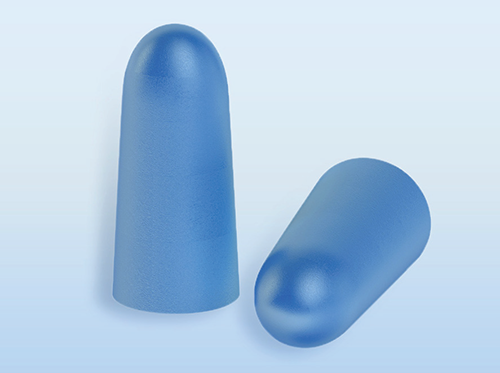
Formable foam earplugs are typically made of soft foam, don't cost much, and are available in many stores. Once inserted, these earplugs expand to fill the ear canal snugly. Generally, foam earplugs are meant for 1 utilise, simply they can be done with warm h2o and mild lather, dried, and reused if they remain clean and they continue to fully aggrandize after they are rolled.

Roll
Pull back and insert
Hold
How to use:
- Insert 1 earplug at a time. With clean hands, ringlet the earplug up into a pocket-sized, thin "ophidian" with your fingers. To avoid making creases, which create tunnels that let in sound, start past using gentle pressure to coil the earplug then gradually increase pressure.
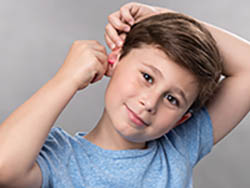
- Pull the top of your ear up and back with your opposite hand to straighten your ear canal and go far easier to insert the earplug. Continue to scroll the earplug before using the other manus to gently slide the earplug into your ear canal so that information technology is affluent with the opening of your ear. You should non accept to force the earplug in, and information technology should never hurt. If information technology does, remove the earplug and try once more.
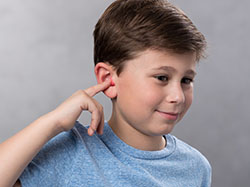
- Gently hold the earplug in identify with your finger for twenty to 30 seconds to requite it fourth dimension to expand.
- Check the fit to brand sure the earplug is comfortable and properly inserted. If information technology starts to expand out of your ear, information technology probably isn't inserted correctly. If this happens, accept the earplug out and attempt again. Accept a buddy look and see if you have inserted the earplug properly, or use a mirror to check the fit.
- Note: For kids, information technology might be difficult to discover cream earplugs that are small plenty to fit all the way in the ear culvert. Never try to cutting the earplugs to make them fit, as this will decrease the effectiveness of the earplugs. If foam earplugs can't exist inserted properly, consider using protective earmuffs instead.
- Repeat these steps to insert a second earplug in your other ear.
- Vocalisation check. When earplugs make a good seal, your voice should sound different to you, maybe louder and/or muffled.
- To remove the earplugs, slowly twist to break the seal with your ear culvert and then gently have them out of your ear.
Pre-molded earplugs are made from plastic, rubber, or silicone. They are sold in different sizes, including sizes that fit children. I type of pre-molded earplug is uniform-attenuation, or high-fidelity earplugs. They have the same effect as turning down the book on a stereo: The sound intensity is evenly decreased beyond different pitches—from the lowest (such as a bass drum) to the highest (such as a flute). You might discover these helpful at movies and concerts, where you want to appreciate the sound quality and protect your hearing at the aforementioned fourth dimension.
How to use:
- With clean hands, and make clean earplugs, insert earplugs one at a fourth dimension, one per ear. For each earplug, gently pull the elevation of your ear up and back with your opposite mitt to straighten your ear canal. Use the other paw to firmly grip the stem of the earplug and gently slide the earplug into the ear culvert, using a rocking movement until you have sealed the ear canal.
- Check the fit. You tin can make sure that the earplugs are fitted properly the same way yous bank check formable cream earplugs: Ask a buddy to look, or use a mirror to see if the earplugs are inserted correctly. Your voice may also audio different to you.
- Advisedly remove earplugs by slowly rocking them back and forth to break the seal with your ear canal. Then gently have them out of your ear.
- Earplugs should be cleaned betwixt uses.
Earmuffs
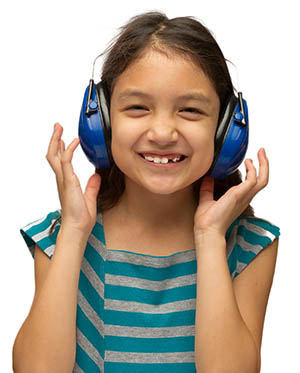
Protective earmuffs are easy-to-use, padded plastic cups connected past a flexible headband. (They aren't the soft earmuffs worn for warmth or fashion.) Protective earmuffs reduce dissonance by completely covering both ears and come in sizes that fit about people, including infants and children. Earmuffs are easier to utilise than earplugs, specially for young children.
Earmuffs might not work also for people who vesture glasses, which can create gaps betwixt the earmuff cushion and the skull. If your child wears spectacles, check to make sure the earmuffs seal properly and are comfy. Certain hair styles or hats could also create gaps that make protective earmuffs less effective.
How to use:
- Grab each loving cup of the earmuffs, one side in each paw, and gently pull apart.
- Place the band over the superlative of your (or your child'southward) caput and slowly release the cups, making certain they completely comprehend the ears and aren't too loose. Your voice should sound different to y'all if the earmuffs are fitted correctly.
Wearing earmuffs and earplugs together tin can further reduce sound, which is great for very noisy environments similar woodshops and shooting sports events.
Formable foam earplugs
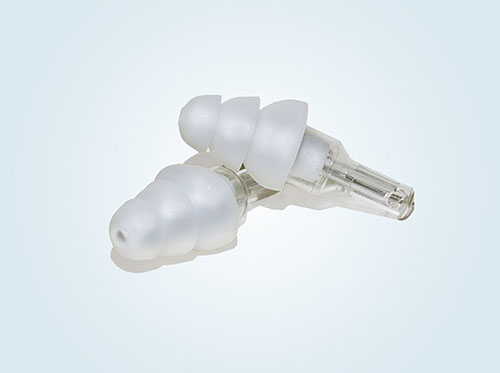
Pre-molded, high-fidelity earplugs
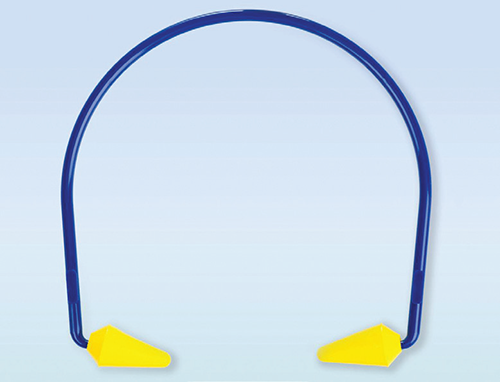
Canal caps
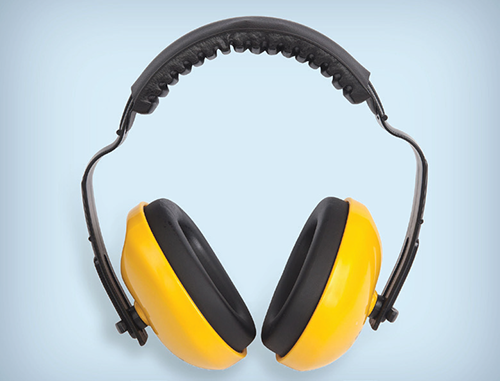
Protective earmuffs
Tips to Help Your Children Use Hearing Protectors

Just every bit y'all teach your children to clothing sunscreen, a seatbelt, and a bicycle helmet, you can teach them how and when to wear hearing protectors.
- Set clear rules for when to vesture hearing protectors. Tell your children that you wait them to wear hearing protectors in noisy areas, fifty-fifty when y'all aren't at that place to supervise.
- Shop for hearing protectors with them. Discuss with your children whether they would rather wear earplugs that can exist hidden by hair or a hat, or brand a fashion statement with more noticeable hearing protectors. Many colorful and comfortable styles of hearing protectors are available in stores and online.
- Choose hearing protectors that fit with your children's activities. Make certain the size and type of hearing protectors work for the surroundings where they'll be used. Recall that if the hearing protector blocks out too much sound, your child might not be able to hear important warning sounds in his or her environment, or might take off the hearing protectors, risking hearing damage.
- Make sure hearing protection is within achieve. Keep hearing protectors for your children in household areas where loud noises are common, but out-of-accomplish of small children and pets.
- Exist a skillful role model. Children learn through observation and false. Set a good example: If you adopt healthy hearing habits, your kids might just do the aforementioned.
Defenseless Without Hearing Protectors?
If you lot forgot your hearing protectors at home or are all of a sudden confronted with a loud noise, cover your ears with your hands. Other ways to protect your hearing are to lower the volume (if possible) or to movement abroad from the noise.
By teaching your children why, when, and how to employ hearing protectors, you empower them to make good for you choices that can protect their hearing now and in the hereafter.
Source: https://www.noisyplanet.nidcd.nih.gov/publications/hearing-protectors-for-noisy-planet
0 Response to "Ear Cover Agains Noise in Library"
Post a Comment